


Automatic exchange of CRS information
Automatic exchange of CRS information
The Automatic Exchange of Information (CRS) is a global system through which tax authorities receive information on the accounts of individuals and legal entities outside their country of tax residence. In 2026, the CRS will be the primary tool for identifying undeclared income and assets.
Jurisprudential helps build a tax and banking model taking into account the CRS AML and international data exchange.
Consultation cost from 250 euros
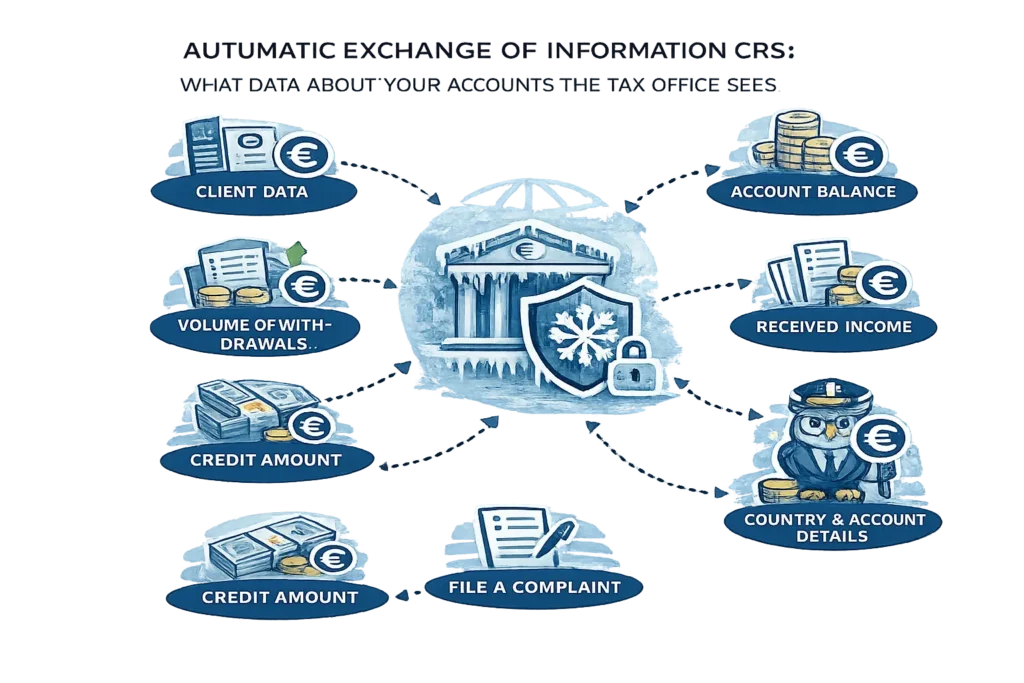
What is CRS in simple terms?
CRS is a system for the automatic exchange of financial information between countries.
How it works
- the bank identifies the client's tax residency
- collects financial data
- transfers them to the tax authorities
- information is sent to the country of residence
The exchange takes place annually and covers most EU countries and international jurisdictions.
What data is transmitted via CRS?
More than just basic account information is transmitted.
The main volume of data
- account holder's name
- address and country of residence
- tax number
- account number
- balance
- financial income
This allows tax authorities to see the real picture of assets.
What income is subject to CRS?
The system covers key sources of income.
Included
- interest on accounts
- dividends
- income from investments
- income from financial instruments
Some structures and products are also subject to reporting.
Is data shared on companies and trusts?
CRS covers more than just individuals.
What is important
- the ultimate beneficiaries are revealed
- control over the company is analyzed
- the ownership structure is being checked
This means that the use of companies does not hide the owner.
How is tax residency determined?
Residency determines where the data will be sent.
What is used
- client self certification
- KYC data
- bank information
Errors in determining residency can lead to risks.
How is CRS related to KYC and AML?
CRS does not work separately.
Unified system
- KYC collects data
- AML analyzes transactions
- CRS transmits information
All elements are interconnected.
How tax authorities use CRS
CRS is an analysis and verification tool.


What do tax authorities do?
- compare data with declarations
- identify undeclared accounts
- analyze income
- initiate checks
Even small discrepancies can raise questions.
Additional level of analysis in 2026
The system has become more technologically advanced.
What changed
- automatic data analysis
- comparison with banking operations
- integration with other sources
This makes control more precise.
Typical errors detected by CRS
CRS most often shows systemic problems.
Common cases
- undeclared foreign accounts
- income discrepancy
- incorrect tax residency
- use of formal structures
This leads to additional charges and fines.
A practical example
An EU resident had an account in another country and failed to declare the income. The tax authorities obtained the information through the CRS and initiated an audit, resulting in additional tax assessments for several years.
How to reduce risks when working with CRS
It is impossible to completely avoid exchange, but risks can be managed.
By recommendation
- declare all accounts and income
- synchronize data between countries
- correctly determine residency
- check self-certification
- take into account AML requirements
This reduces the likelihood of inspections.
How does CRS affect cryptocurrency?
Traditionally, crypto assets have not been fully covered by the CRS.
What's changing
- DAC8 is being implemented
- control is being strengthened
- data begins to be transmitted
This expands transparency.
Who especially needs to consider CRS?
- expats
- entrepreneurs
- to investors
- foreign account holders
Especially with an international asset structure.
Сonclusion
The CRS's automatic exchange of information makes bank accounts transparent to tax authorities worldwide. By 2026, the system will not only transmit data but also enable its automated analysis.
With integration with AML , banking compliance, and expanded DAC8 controls, any discrepancies between declarations and actual data are quickly identified. This means concealing assets or income becomes virtually impossible.
A well-designed tax structure, accurate residency determination, and complete transparency allow you to manage international accounts without the risk of audits and sanctions.