


Cryptocurrency Card Use in Europe: What Data Are Regulators Seeing?
Cryptocurrency Card Use in Europe: What Data Are Regulators Seeing?
The use of crypto cards in Europe is often perceived as a convenient way to spend cryptocurrency without contacting the banking system. In practice, a crypto card is a fully regulated instrument that connects crypto assets to the fiat infrastructure and makes transactions transparent to regulators.
Jurisprudential builds secure models for the use of crypto assets, taking into account the CRS AML MiCA and EU tax legislation.
Consultation cost from 250 euros
What is a crypto card and how does it work?
A crypto card is a payment instrument linked to crypto assets that allows you to pay for purchases in fiat.
How does the operation take place?
- The user pays for the product or service
- The crypto asset is automatically converted to fiat
- The payment goes through the payment system
- Funds are debited from the crypto account
In fact, every transaction is a sale of cryptocurrency.
Why a crypto card is not an anonymous tool
Unlike non-costodial wallets, a crypto card is always associated with an identified user.
What does the registration process include?
- Full KYC
- ID confirmation
- Tax residency
- Verification of the source of funds
Without completing these procedures, it is impossible to use the card.
What data do regulators see?
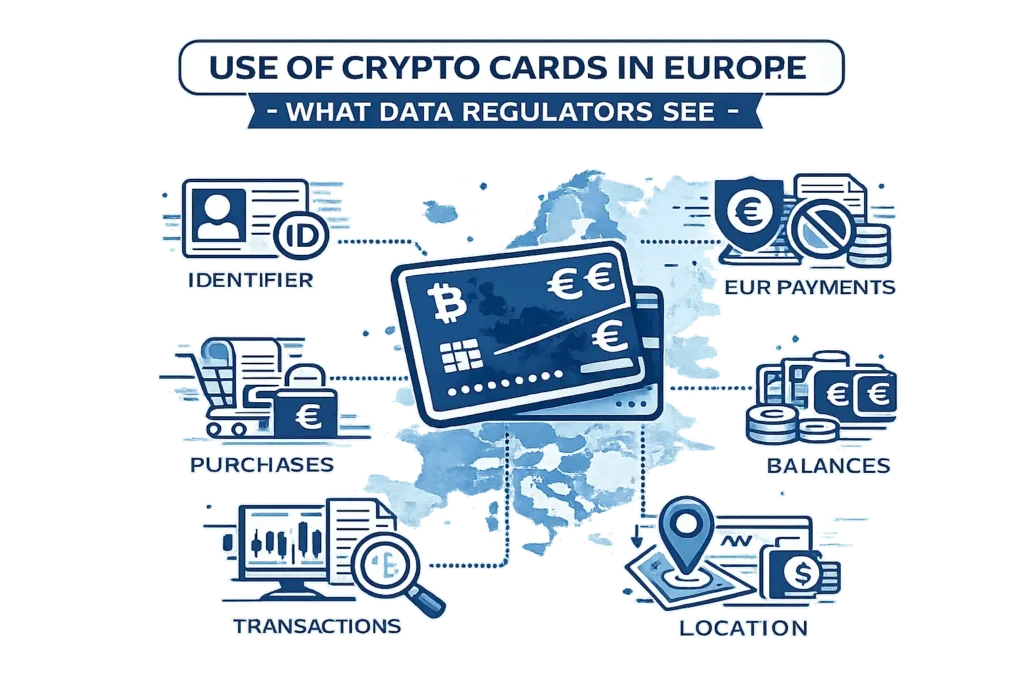
The crypto card generates a large amount of information that is available to financial institutions and tax authorities.
Main categories of data
- Personal data of the owner
- Transaction history
- Crypto asset balance
- Geography of operations
- Linked bank accounts
This data can be transmitted within the framework of CRS and DAC8.
The Role of AML and KYC in Using Crypto Cards
Crypto cards are under strict control of financial regulators.
How does control work?
- Real-time transaction monitoring
- Risk assessment of operations
- Customer behavior analysis
- Automatic check triggers
Any non-standard activity may result in a request for information.
Tax implications of using crypto cards
Every payment made with a crypto card may generate a tax liability.
When does tax arise?
- Cryptocurrency conversion at the time of payment
- Profit taking
- The difference between buying and using
This means that even everyday expenses can be taxable events.
How does the data reach tax authorities?
The EU's information exchange system is already functioning comprehensively.


Transmission channels
- CRS for banking and payment data
- DAC8 for crypto assets
- Internal reports of providers
The data is automatically compared with tax reporting.
Which operations are of particular concern?
Some scenarios result in checks more often.
Main triggers
- High turnover on the card
- Frequent cryptocurrency conversions
- Income and expense discrepancy
- Using the card in different countries
Banks and providers are obliged to respond to such signals.
A practical example
An EU resident actively used a crypto card for everyday expenses without declaring his income. Upon analyzing the transactions, the bank discovered a discrepancy between his official income and expenses. This led to a document request and a tax audit.
Why the Crypto Map Enhances Transparency
Unlike storing crypto assets, using a card creates a constant stream of data.
What is important to consider
- Every transaction is recorded
- The data is easily compared
- The connection with personality is obvious
This makes the crypto card one of the most transparent instruments.
How to use crypto cards safely
Crypto cards can be used without risks if structured correctly.
By recommendation
- Declare income
- Keep records of transactions
- Confirm the source of funds
- Take into account the requirements CRS AML and Mica
- Plan your tax burden
It is important to view the card as part of the financial system, not as a workaround.
For whom it is especially important to consider risks
- For crypto investors
- Digital nomad in the EU
- For online business owners
- For users of high-volume crypto cards
Especially for those who use cryptocurrency for everyday expenses.
Сonclusion
The use of crypto cards in Europe makes crypto transactions as transparent as possible for regulators. Data on transactions, users, and assets is available through the financial control system.
It is a convenient tool, but it requires full tax and legal discipline.