


How to legally reduce the tax burden in the EU through strategy and structure
How to legally reduce the tax burden in the EU through strategy and structure
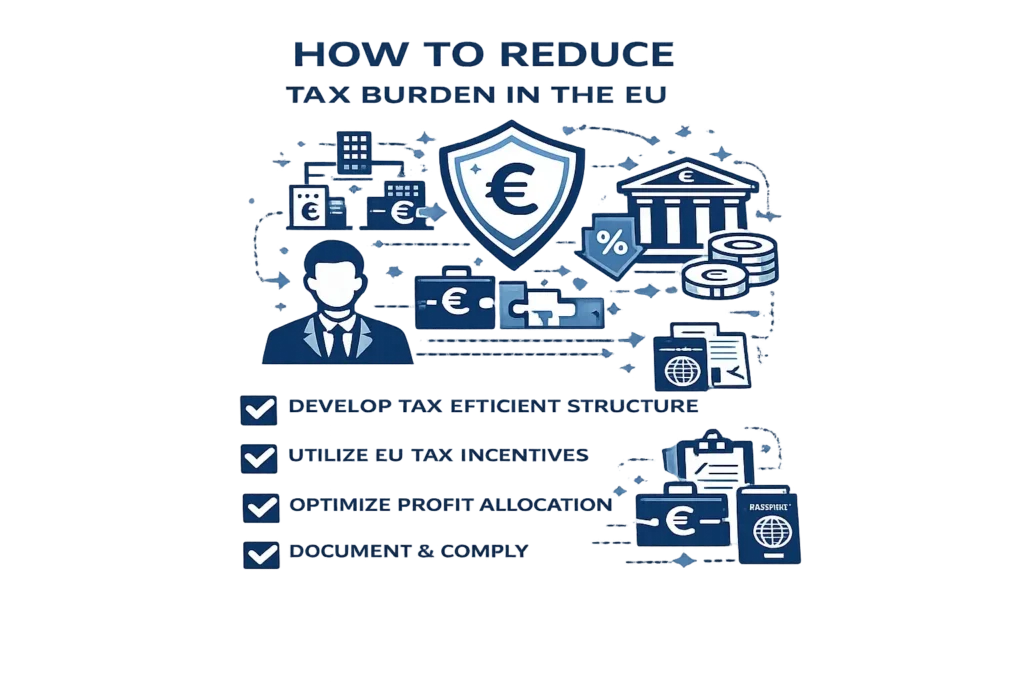
Working and doing business in Europe doesn't automatically mean high taxes. Reducing your tax burden in the EU depends not on the schemes, but on the right tax strategy, income structure, and choice of residency.
Attempts to act without a strategy lead to overpayment of taxes, double taxation and questions from banks regarding CRS and AML.
Jurisprudential helps develop a tax model that reduces the burden and complies with European legislation.
Consultation cost from 250 euros
Tax residency as the basis of the entire strategy
The first and key factor is tax residency. This determines where you are required to pay taxes and on what income.
The EU operates under the worldwide income principle. This means that tax residents are required to declare all income, including
1. business profit
2. dividends
3. investments
4. cryptocurrency
5. foreign accounts
If residency is determined incorrectly, double taxation is possible.
Tax authorities consider not only the number of days but also the center of vital interests. If you live in one country and conduct business from another, both may be subject to taxes.
Revenue structure as a tool for reducing taxes
Different types of income are taxed according to different rules. This allows for optimization.
Main types of income:
1. salary
2. company profit
3. dividends
4. investment income
In many EU countries, wages are taxed on a progressive scale with high rates. However, dividends and corporate profits may be taxed differently.
Proper distribution of income allows you to reduce the final tax burden without breaking the law.
Business management and taxation
It is important for entrepreneurs to understand where profit is created.
If you:
1. Make strategic decisions
2. Manage a team
3. Control financial flows
from a specific country
This country may believe that profit is created there.
and tax it
Even if the company is registered in another jurisdiction.
Use of international agreements
The EU actively applies agreements to avoid double taxation.
They allow:
1. Determine where to pay taxes
2. avoid double taxation
3. credit already paid taxes
But it's important to understand that agreements don't work automatically. They must be applied correctly, taking into account the business structure and revenue.
CRS and financial transparency
The CRS system makes the EU tax system as transparent as possible.
Banks automatically transmit information about:


1. accounts
2. remnants
3. movement of funds
tax authorities
This means that it is impossible to hide income or residency.
Therefore, an effective strategy must be completely legal and consistent with the actual structure of the business.
Optimization through business structure
The correct business structure allows you to control the tax burden.
It is important to consider:
1. Where is the company registered?
2. Where is the management located?
3. How are profits distributed?
4. How are dividends paid?
Sometimes a transfer of control or a change in the ownership structure can have a significant effect.
Investments and capital taxation
Investment income is taxed separately.
This includes:
1. dividends
2. percent
3. Profit from the sale of assets
Different EU countries apply different approaches. In some cases, the tax on capital may be lower than that on earned income.
A competent asset structure allows you to reduce the tax burden.
Typical mistakes of entrepreneurs
In practice, the most common ones are:
1. Selecting a country based only on tax rate
2. ignoring tax residency
3. Operating a business from the wrong country
4. lack of income structure
5. failure to declare foreign accounts
These errors lead to overpayment of taxes and the risk of audits.
How to Build an Effective Tax Strategy
To reduce the tax burden in the EU, it is important to consider:
1. tax residency
2. business structure
3. types of income
4. international agreements
5. CRS requirements
An integrated approach allows:
1. Reduce taxes legally
2. avoid double taxation
3. Protect assets and accounts
4. Increase business sustainability
Consultation on reducing the tax burden in the EU
Reducing the tax burden in the EU is a matter of strategy, not schemes.
This is especially important if you:
1. entrepreneur
2. investor
3. work remotely
4. Do international business?
Jurisprudential helps develop a tax model that reduces the burden and fully complies with European legislation.